title: "How to cut your grocery bill by $200/month without eating worse" description: "Budget Mode builds meals around what's cheap, what's in season, and what you already have — without making dinner feel like a sacrifice." publishedAt: "2025-02-18" author: "Suprabha" category: "budget" tags: ["grocery savings", "budget cooking", "meal planning", "food costs", "frugal"]
I'm a CPA. I've helped dozens of clients find money they didn't know they were losing.
The most common place? Groceries and food.
Not because people are careless — because the system is designed to make you spend more than you intend to. Impulse buys at the checkout. Buying ingredients for one recipe that you never use again. Ordering takeout because you didn't plan and now it's 6:30 PM.
Here's how to fix it systematically.
The three places grocery money disappears
1. Unplanned shopping
When you shop without a list tied to a specific meal plan, you buy aspirationally. You buy the fancy cheese because it looks good. You buy the ingredients for a recipe you saw on Instagram. You buy "just in case" items that never get used.
A meal plan with a precise grocery list eliminates this. You buy exactly what you need. Nothing more.
2. Food waste
The USDA estimates the average American household wastes 30–40% of the food it buys. At $200/week in groceries, that's $60–80 in the trash every week.
The fix: plan meals that use the same ingredients across multiple nights. Buy a whole chicken, use it three ways. Buy a bag of spinach, use it in two different meals before it wilts.
3. Takeout as a fallback
The average American household spends $3,000+ per year on takeout. Most of it happens not because people want takeout — but because they didn't plan, it's late, and cooking feels impossible.
A plan that's actually usable on a Tuesday at 6 PM eliminates most of this.
What Budget Mode does
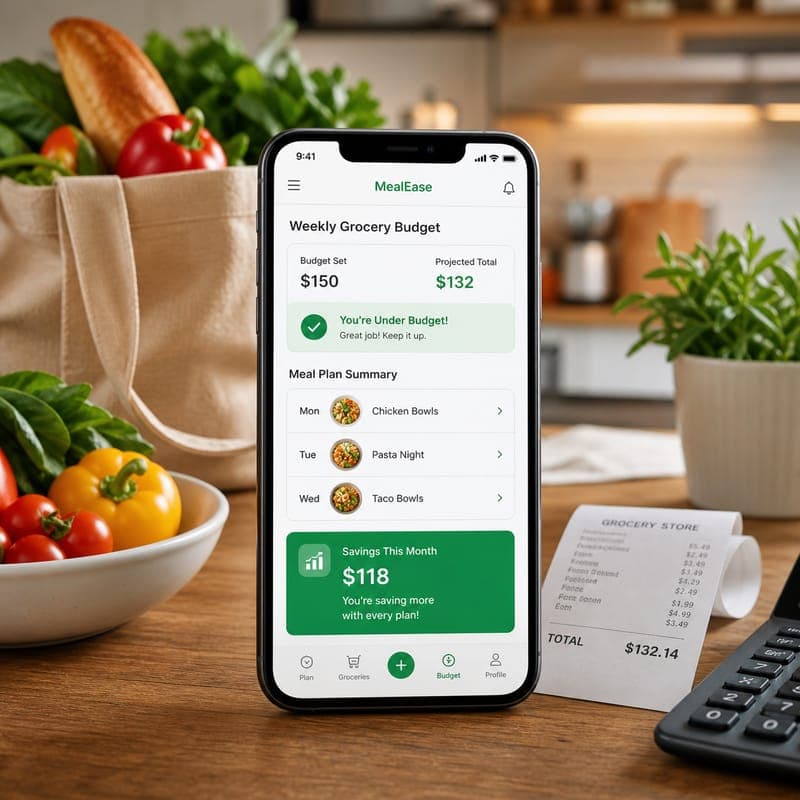
Budget Mode is a filter in MealEase that prioritizes meals based on cost per serving.
When you enable it, the AI:
- Favors proteins that are cheaper per serving (chicken thighs over chicken breast, eggs, legumes, canned fish)
- Suggests meals that use pantry staples you already have
- Builds plans that share ingredients across multiple nights (reducing waste)
- Avoids recipes with expensive specialty ingredients
- Flags when a suggested meal is unusually cheap vs. your typical spend
The result: a week of dinners that costs 20–30% less than your current grocery spend, without feeling like you're eating worse.
The ingredient overlap strategy
This is the highest-leverage thing Budget Mode does.
Instead of planning 7 independent meals that each require different ingredients, it plans meals that share ingredients:
- Monday: Roast chicken thighs with roasted vegetables
- Tuesday: Chicken and vegetable fried rice (using Monday's leftovers)
- Wednesday: Lentil soup (pantry staple, cheap, filling)
- Thursday: Sheet-pan salmon with the same vegetables from Monday
- Friday: Pasta with whatever's left
Five nights. One grocery run. Minimal waste. Total cost: roughly $60–70 for a family of 4.
What $200/month in savings actually looks like
- Grocery spend: down 15–20% from eliminating unplanned purchases
- Food waste: down 50–60% from ingredient overlap planning
- Takeout: down $100–150/month from having a plan that actually works on tired nights
That's $200–300/month for most households. $2,400–3,600/year.
Not from deprivation. From having a system.
— Suprabha
Dinner without the nightly reset
Turn tonight’s idea into a plan.
Plan dinners with the grocery total in view.
About the author
Suprabha is a MealEase co-founder, CPA, and parent who writes about the practical side of feeding a busy household.
How we created this guide
This guide was written from MealEase product workflows, common household meal planning patterns, and the practical questions families ask around budget.
Downloadable planning tools
Get the next one in your inbox.
One email a week, never more. Cancel anytime.